Sunday, 5 April 2020

Revisiting Ayodhya : In the eyes of Law


Introduction
India in the late 1980s was recovering from horrors of emergency, redeeming its social-political endeavours and constitutional governance. It was a phase where even the courts in India took “activism” as only virtues to brush off the blot of credibility and inability to secure rights of Individual. This was an era of coalition politics where amidst political in-stability India was moving away from nationalisation to liberalization when the opening of the market became quintessential for its survival. It was poised on the path of development when an unprecedented, unfortunate event in Ajodhya, Uttar Pradesh took place which changed the course of policies, way of politics, elections and affected generations in India. This event of desecration of Babri Masjid on 6th December 1992 changed fortunes of India from liberalization to Politics of “Mandal-Kamandal” which became the only narrative of big political parties thriving on which some went on govern India.

It was on 8th November 2019 when finally the Constitution Bench of ex CJI Ranjan Gogoi, J SA Bobde, J D Y Chandrachud, J Ashok Bhushan and J Abdul Nazeer in M. Siddiqui v. Mahant Suresh Das[1] laid the long-standing title dispute which was religious and “political fodder” to rest by unanimously directing Construction of Temple and Allocating a separate 5 Acre land to Sunni Waqf Board for construction of the mosque, invoking Article 142 of the constitution.[2] In allowing to temple to come up the Supreme Court has chosen the path of “peace” for communal harmony and Justice but the bitter truth is that legal principles in here seems to be compromised and the decision appears to be on “faith”. While the decision undoubtedly puts a full stop to the “specific” issue urbanely it is yet dubious that this may impact communal harmony. The Judgement therefore like every other is subject to critique on spokes of law and has received a backlash over choosing faith over the law as soon as it was read out[3]. In its 929 run page, no conclusive and the compelling argument were put out for the justification of the decision and while it started with “Court does not decide title on the basis of faith or belief but on evidence” the judgement itself does not appreciate the “rule of evidence”. This judgement, therefore, looks more like a Supreme Court’s Balancing act which is jeopardized and compromised.

It is pertinent to highlight the object and lay the course of this article at this stage.While we try to dwell into the legality of the Judgement on settled principles of law, the endeavour is not to try finding answers to controversial questions pertaining to the existence of structure “historically” or on religious curves thus not enquiring into faith or belief and try to understand the inconsistency in appreciation of evidence and the conclusion.

The Build-up
This case is an example of ‘changing status quo’ and the question for the judges was to determine the dispute on land where the structure already exists. Historically there are questions on its inception but the court in its observation accepts “It was a mosque which existed for over 450 years” which is well before the independence when we did not have a instrument or document to self-govern.
However, “On 15th August 1947, India as a nation realised the vision of self-determination and on 26th January 1950 we gave ourselves the Constitution of India as an unwavering commitment to the values which define our society”


What laid the foundation to this dispute and forms as the important incident is sine qua non for the understanding of the complex issue? It was on midnight of 22-23 December 1949 when Hindu Idols were surreptitiously placed inside Babri Masjid by 50-60 persons and an FIR under section 147, 295, 448 of Indian Penal Code was lodged. This incident was followed by a disruption in offering prayer in the structure thereafter. The court in paragraph 798 observes that, “The ouster of the Muslim on that occasion was not through any lawful authority but through an act which was calculated to deprive them of their place of worship.

This incident and observation become crucial because this was not only against the law but also it deprived the Muslims of a mosque which had been constructed well over 450 years ago. This became a pertinent point for determination on “possession” which we shall see later.

Secularism and Place of Worship Act 1991
India homes the word “secular” in the preamble and the observation made by the judges in this judgement also affirms to the “Secularism as Constitutional Principle”. In Paragraph 83 of the Judgement the courts accepts the observation of J BP Sanjeeva Reddy in S R Bommai v. Union of India[4]
“How are the constitutional promises of social justice, liberty of belief, faith or worship and equality of status and of opportunity to be attained unless the State eschews the religion, faith or belief of a person from its consideration altogether while dealing with him, his rights, his duties and his entitlements? Secularism is thus more than a passive attitude of religious tolerance. It is a positive concept of equal treatment of all religions. This attitude is described by some as one of neutrality towards religion or as one of benevolent neutrality. This may be a concept evolved by western liberal thought or it may be, as some say, an abiding faith with the Indian people at all points of time. That is not material. What is material is that it is a constitutional goal and a basic feature of the Constitution as affirmed in Kesavananda Bharti [Kesavananda Bharti v. State of Kerala, (1973) 4 SCC 225: 1973 Supp SCR 1] and Indira N. Gandhi v. Raj Narain [1975 Supp SCC 1: (1976) 2 SCR 347]. Any step inconsistent with this constitutional policy is, in plain words, unconstitutional”

Secularism, therefore, is as quintessential to the Indian constitutions as any basic principle as it empowers and underlines the essence of inclusiveness of society, the “Idea of India”. To avoid any such coerced conversion of any existing place of worship, the government in 1991 passed “Place of worship Act”. This was an effort to, in future, by mandating that the character of a place of worship of shall not be altered and it seeks to “impose a positive obligation to maintain the religious character of every place of worship as it existed on 15th August 1947. The idea of The act is to strengthen the secular principles of the Constitution, however, “The disputed Babri Masjid” was kept out of the scope of the Act which raises doubts on the intent of the act and the political will.

The arguments in the case were manifolds and here we try to highlight the discrepancy in Courts Observation, a departure from settled principles of law and in placing a particular faith at a higher pedestal.


The ASI Report

The Archaeological Survey of India was tasked to submit its report on the structure beneath the Masjid and determine the title. However, there was no evidence available on (i) the cause of the destruction of the underlying structure and (ii) whether the pre-existing structure was demolished for the construction of the mosque. It observed that there was a non-Islamic structure beneath but did not admit on the structure being a Temple. Therefore the finding of title could not be based in law on archaeological findings which have been arrived by ASI. (Refer to Page 907) In simplified words, the court could not find the ASI Report conclusive for determination on what structure was lying beneath the ‘tangible’ and ‘visible’ Babri Masjid.

The question of Restitution

The Muslims were dispossessed upon the desecration of the mosque on 22/23 December 1949 which was ultimately destroyed on 6 December 1992. There was no abandonment of the mosque by the Muslims. The Court in Paragraph 801 agrees that the Destruction of The Mosque in 1992 was unlawful and hence it is necessary to provide “restitution” to the community. In this furtherance, it invoked Article 142 to give 5 Acre of lands. It may look reasonable but legally it is nothing close to the accepted and used definition of restitution. Restitution in its classical sense “restoring its original sense” as observed by many jurists over the years and not “compensate” the victim. Here the court departed from its true meaning of “Restitution” in invoking article 142 to allow 5 Acres of land to Waqf Board and defeats the settled legal principles and has erred in the jurisprudential interpretation as the status quo was not actually 'restituted'

The doctrine of Adverse Possession
Often said as 9/10th of ownership, Possession as per Salmond is “most basic relation between men and things. The possession of a material object can be said to be continuing exercise of a claim to the exclusive use of such object” To prove possession of Physical control (Corpus Possessions) and Intention (Animus Possesidendi) is imperative. In this case, there was a plea of “Adverse Possession” . To make a successful claim of Adverse possession, the person making such a claim shall establish both, possession which is peaceful, open and continuous and possession which meets the requirement of being nec vi nec and nec pecario.

In paragraph 748 the court rejects the plea of adverse possession of the Waqf board because it could not adduce evidence of the land belonging to it exclusively and continuous possession beginning from the time the mosque was built. It conveniently ignored the reason for breakage of “continuity” which was desecration and conversion of the place of worship, which is a separate observation the court observed as illegal.

Preponderance of probability

To a very long time in the text of judgement it appears none of the party has made a conclusive claim and the decision would be on “better evidence” until it invokes “Preponderance of probability”. POP is a well-accepted doctrine which endeavours to balance the evidence and weigh it accordingly, it accepted that there is clear evidence to worship by the Hindus in the outer courtyard continued unimpeded in spite of the setting up of a grill brick wall in 1857. It is also notable that the place of worship was shared by both parties but two instances; first setting up idols in 1949 and destroying the dome in 1992 made the other party devoid of the place of worship. When a structure is physically standing, Generally it should be the onus of the party contesting the ownership to prove its claim. Here the court with these words “The Muslim has offered no evidence to indicate that they were in exclusive possession of the inner structure prior to 1857 till the date of construction” ruled in the favour of the temple by not taking the above two instance, co-existence post-1857 into account and reversing the onus 


Conclusion

The idea here is to understand the legality of the judgement and place it contextually with constitutional principles and rule of evidence. It, on the one hand, denied Juristic Personality to Ram Janambhoomi, Barred the claim of Nirmohi Akhara, Accepted that the Muslim by an act of destruction are devoid of the place of worship, Rejected ASI Report 2003 yet shifted the onus to the Waqf to claim its ownership. The Supreme court may have done an act of balance to put this dispute to the grave for larger good but it is highly problematic to place faith over others by it and it may mark an end to the long-standing dispute however legally it would not go as very well-reasoned the judgement of SC and should not be referred to as "good precedent" rather shall be left in isolation as an  extraordinary judgment in view to streamline the communal tension in the country.


All Images are subject to copyright


Thursday, 20 February 2020

Challenges in Judicial Process


The Supreme Court of India is often termed as the most powerful court in the world, because of the wide discretionary power wielded by it and its role in shaping the country’s jurisprudence. In the current judicial cosmology the Supreme Court of India is the apex court to decide the matter of constitutional importance, acts as a court of appeal and has original jurisdiction to adjudicate between states, centre and state(s). Therefore the layer of judiciary begins with, loosely speaking, lower courts in each district which acts as the first point of adjudication, generally, the High Courts in almost every state and thereafter the Supreme Court.
However, when we talk about the most powerful court, is it restricted to the power it envisages or does it also include the wide access to justice to its citizens? When the Supreme Court was formed, there was apprehension in the minds of the Constitution makers regarding the access to justice to all. The Constituent Assembly’s will and spirit for promoting wide access was clearly elucidated through the words of Pandit Thakur Das Bhargava, who argued that there should be liberalization of the jurisdiction, and that it should be seen in all fit and proper cases that the ordinary man gets full justice. Dr B.R. Ambedkar, often referred to as the father of the constitution, labelled Article 32 as the heart and soul of the Constitution, as it provided the citizens the right to directly approach the court, in case of violation of fundamental rights. Without this article, the Constitution would be reduced to a nullity.[1]
 But on the other hand, there were few who were apprehensive about the wide discretionary power given to the court, to hear appeals. Biswanath Das had argued that the Constitution’s provisions for interminable appeals from court to court would only serve to profit lawyers. He also raised the issue that if there is justice based on the truthfulness of facts then it must be had in the preliminary court or in the subsequent appellate court.[2] Contemplating the words of Dr B. R. Ambedkar, the prime purpose or goal of the Supreme Court is to deal with cases involving substantial question of law or the interpretation of the Constitution. But over a period of time, because of the admissibility of the type of cases, it has reduced itself to a court of appeal.
In the words of former Chief Justice of India, T.S. Thakur and Justice Deepak Misra 98% of the estimated working time of the Supreme Court judges is supposedly wasted in dismissing such cases of appeal.[3] Also, through empirical data, it has been established that in 2011, of all the appeals to the Supreme Court, 34.1% of the cases represented only 7.2% of the total population in India.[4] Thus, the vision of the Constitution makers to provide wide access to all stands on a futile ground.

Pending Vacancies and Backlogs of cases

The National Court Management Systems (NCMS) formulated in 2012 by the Supreme Court predicted that the number of cases in Indian courts will increase to 15 crores by 2040, requiring the creation of 75,000 courts.[5] This means the judiciary has worked almost at its 75% of strength if not full to ensure access to justice to all. However, if India were to work with a full capacity of judges today it would encounter chronic shortfall of at least 5000 courtrooms and Judicial Infrastructure.
The centre had set a target of completing the construction of 2,730 court halls within the financial year 2018–19. Going into the next decade, India will still be short by half of what it needs in the way of court rooms. The slow pace of building new courtrooms will influence the pace of judge recruitment, and if any state revises the sanctioned number of judges upwards and actually fills the posts any time in the near future, the shortage of court halls will become ever more acute[6]
There has been acute reluctance by governments in budgetary allocation to the judiciary and then spending it on the courts actually. In the year 2015-16, Only Delhi spent 1 % of its allocated budget while nationally the spending is at of 0.8%[7]

As per India Justice Report 2019[8] at all India level there is just one subordinate court judge for 50,000 people. It includes almost 17-19 large-sized states which assimilate 90% of India’s population.
Ex CJIs J.  S Kehar and Deepak Misra while highlighting the apathy of non-appointment and mammoth number pending cases expressed concern over that 98% of the estimated working time of the Supreme Court judges is supposedly wasted in dismissing  cases of appeal and that India needed minimum of 70,000 Judges to clear existing backlogs.
As per National Judicial Data[9] grid up till 2019 June across India’s subordinate courts --- the first port-of-call for most cases --- more than a third of the 31 million cases have been pending for more than three years. In the High Courts, the pendency is even higher: half of all the 8 million cases in the High Courts have been pending for more than three years.[10]

Year
0 to 1 Years
1 to 3 Years
3 to 5 Years
5 to 10 Years
Above 10 Years


District and Subordinate Court Cases
11426.2
8392.27
4290.36
4593.59
2541.149


High Court Cases
2177.88
1757.79
1094.62
1518.98
1410.273

The State of Odisha which has highest clearance rate of pending cases (106%) still has its 38% of its cases lingering in the subordinate courts for at least five years. Hence as per the India Justice Report, the pendency of cases is at ever increase at a subordinate level which on an average has a minimum 5 year time as average clearance per case
Recently the number of judges was increased from 31 to 34 when in 18 years for the first time it was working in its full strength but remaining of the courts are chronically understaffed. The sanctioned strength of India’s High Courts is 1,049 but currently, there are only 680 judges in office (a vacancy rate of 37%). Similarly, in the lower courts, the vacancy rates for judges is at 25%.[11]

At lower judiciary level there has been the vacancy on the rise but since there is no normative time period stipulated the appointment sometimes varies from one to two years. Even with increase of vacancies and appointment, India is effectively operating with half of its strength. These are all issues therefore linked with each other in a circle where less judge’s results more pendency and pendency calls for the appointment of more judges. Over the years, various commissions have laid out several recommendations to tackle the issue comprehensively. For instance, the 11th Finance commission in 2005 had recommended the formation of fast-track courts to expedite cases. More recently in 2014, the 245th Law Commission recommended setting up special courts adjudicated by recent law graduates to hear more trivial cases (such as traffic offences) and raising the retirement age of judges in lower courts. Last year, the Law Minister, Ravi Shankar Prasad had suggested implementing a centralized recruitment system for lower courts along the lines of the Union Public Services Commission

Unpopularly there has been a view of the division of Supreme Court into a separate constitutional court and the court of appeals was conceptualized and recommended multiple in 95th and 229th law commission reports and Parliamentary Standing Committee Reports times to the government with the intent of having dedicated and the specialised constitutional court which would interpret only the matters pertaining to the constitution and a different court of an appeal,  which would be the highest court of appeal after respective high court thus have a greater degree of independence and sanctity of the supreme court and providing wide access to justice.
Another facet of Judiciary which is constitutionally mandated is for ensuring its independence from the executive and upholding quintessential constitutional values. The Judiciary hence is not the only guardian of the constitution but also a torch bearer of democratic spirit and not letting it succumb to Majoritanriaism. It is what we may say anti-thesis to the non-democratic regime but over the years it has seen a dilution in the idea. There are various reasons for Judiciary’s inability to be as effective which was originally conceived of, pending vacancies, backlog in cases and the trust deficit is haunting and plaguing the Judiciary and this calls for a time for the institution itself to reform and redeem itself in order not only to provide justice but let it be seen when done.


5.    

[1] Statement by Dr. Ambedkar, Constituent Assembly Debates, 953 (Dec. 9, 1948). Dr. Ambedkar, however did not seem to imagine that the Supreme Court would fully hear cases involving fundamental rights under its original jurisdiction, but rather that it could grant interim relief in appropriate cases
[2] Statement by Biswanath Das, Constituent Assembly Debates, (June 6, 1949).
[3] All you need to know about National Court of Appeal, The Hindu, (April 28, 2016), http://www.thehindu.com/news/national/national-court-ofappeal-the-hindu-explains/article8532094.ece.
[4] Nick Robinson, A Quantitative Analysis of The Indian Supreme Court’s Workload, http://www.cprindia.org/sites/default/files/articles/SSRNid2189181.pdf
[5] J Ranjan Gogoi in an address to District Court  new Delhi, 2013
[6] https://www.barandbench.com/news/india-justice-report-on-the-judiciary-average-case-pendency-in-subordinate-courts-is-5-years
[7] http://www.cbgaindia.org/wp-content/uploads/2019/01/Memorandum-on-Budgeting-for-Judiciary-in-India.pdf
[8] https://www.barandbench.com/news/india-justice-report-on-the-judiciary-average-case-pendency-in-subordinate-courts-is-5-years
[9] National Judicial Data Grid , https://njdg.ecourts.gov.in/njdgnew/?p=main/pend_dashboard
[10]Vishnu Padmanabhan , India’s next generation reforms must begin in courts , live mint ,  https://www.livemint.com/news/india/india-s-next-generation-reforms-must-begin-in-courts-1560838699823.html
[11] Supreme Court of India, https://main.sci.gov.in/

Sunday, 15 December 2019

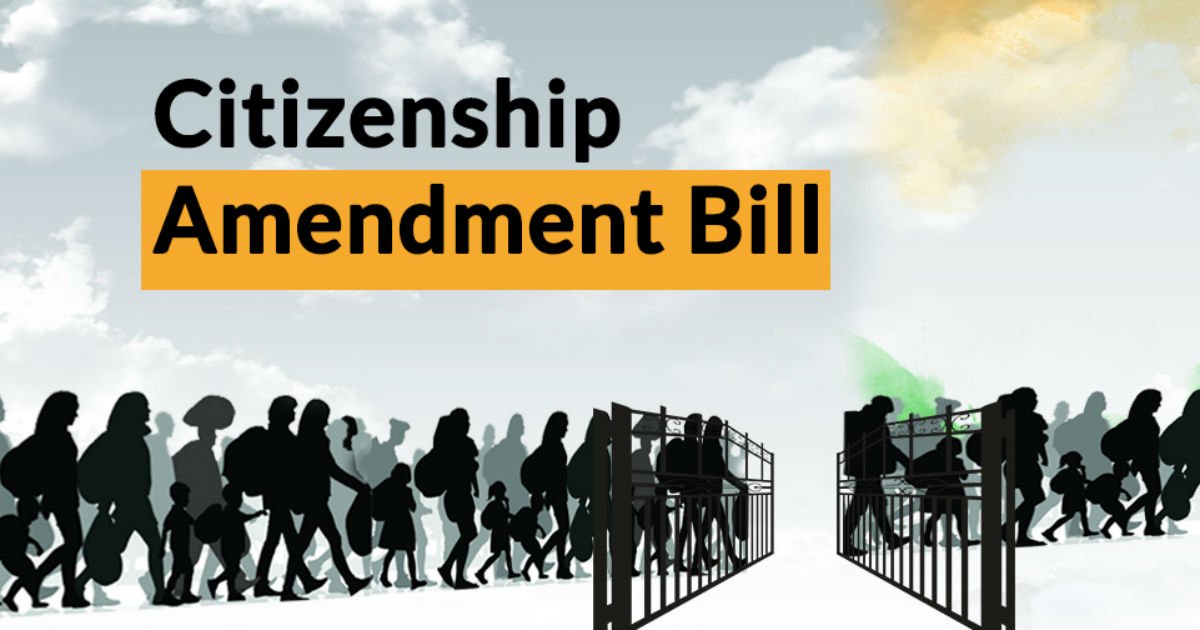
Citizenship Amendment : A divisive - stepping stone to 'New India' ?


Introduction

The President late night, amidst the huge uproar, on Thursday, December 12th gave assent to the controversial Citizenship Amendment Bill (CAB) and it became a reality, which is by far and there is no exaggeration in it if I say  the stepping stone to New India, when India prepares to grant citizenship to certain minorities of three specific countries coming in its territory but on the basis of ‘religion’.  The Act  is a reality which was vehemently opposed when it was conceived in the Cabinet, passed in both houses of Parliament and discussed on streets with the pretext of notorious NRC (National Register for Citizen) and this government’s Hindu Nationalist Agenda  however the government has claimed it to be moral, legal, constitutional and most importantly ‘Inclusionary’. The constant explanation by  government has not been able to convince its people across the country especially in North East and consequently the region including Assam, Tripura and some places like Aligarh has witnessed the dissent being muzzled down when they took their protest on streets witnessing  internet services  discontinued in above places to ensure peace and kill the dissent  but the voices are loud enough to reach deaf ears in Delhi and shake the dead consciousness of people of this country.

These protest is not confined to particular places to name but has taken a nation-wide shape with Delhi, Mumbai, Karnataka, Lucknow etc. joining in with high spirits. The displeasure for such step has taken an international turn with Bangladesh Foreign and Home Minister cancelling their visit to India amidst protest[1] and UNHRC expressing concerns as it is ‘Fundamentally Discriminatory’ in nature. It also received a strong opposition by fellow parliamentarians like Manish Tiwari, Sanjay Singh, Shashi Tharoor, Sanjay Raut, Manoj Jha, Owaisi, Kapil Sibbal and P Chidambaram.
The protests, therefore, can be viewed in two different but related spectrum which is ethical/moral and legal. While the debate may be unending on the moral values of a government (if any) are truly in lines with the rich culture of Vasudev Kutumbakham which we graciously took pride in, it is relatively easier to break down the CAB( Now CAA) with a legal understanding. However, It is important to understand and debunk first and foremost the factual inaccuracy premised on which the Home Minister while presenting the bill called out that “If it was not for Congress’s misdeed of doing partition on religion, we would have not required this legislation”[2]  

This is patently inaccurate and misleading       as per the “Object” of the Constituent      Assembly read out by J. L Nehru which later on became the preamble no ‘State religion’ was declared. The idea of state religion was not only rejected by Dr B R Ambedkar as it will bring chaos and apathy but also     despised by him and hence even on multiple resolutions, the preamble did not accommodate any religion in itself. Contrarily it was V D Savarkar who inclined with Jinnah [3]in 1937/1938 demanding two separate nations for Hindus and Muslim “Who are essentially different that co-existence is not possible” Fortunately in history we did not subscribe to that opinion until now.


The Amendment:
The Act amends Section 2 (b) of the Citizenship Act – which defines 'illegal immigrants' – by excluding "persons belonging to minority communities, namely, Hindus, Sikhs, Buddhists, Jains, Parsis and Christians from Afghanistan, Bangladesh and Pakistan"[4] from the ambit of "illegal immigrants".  It also reduces the period of residence in India for the acquisition of Indian citizenship through naturalization to six years from the earlier period of twelve years.


It therefore makes classification of “Illegal migrants” on basis of religion includes Hindus, Sikhs, Buddhists Jains Parsis and Christians but excludes only Muslim. The justification given by the Hon’ble Home minister in house is that firstly the illegal migrants applying shall be religiously persecuted and secondly these three countries are Islamic countries and the Majority community which is of Muslim will not be persecuted. It becomes now important to understand that the Act in its essence nowhere talks of Persecution and secondly the government’s idea was based on flawed logic of minority not being persecuted while we have examples of Ahmadis in Pakistan. It also does not strategically includes countries like Sri Lanka and Myanmar. This howsoever is a policy decision and shall not be of problem to defend in the court of law.

The Validity
It was argued by two experts in the JPC report tabled this January that CAB in its tessence is violative of Constitution[5] and the government however proceeded with it.  My central argument revolves around two major points which can be broken down further, on its constitutional validity Firstly It is violate of Article 14 of the Constitution which applies to all “person” in its territory and is manifest arbitrariness by the legislature. Secondly, Secularism is a basic feature of our Constitution and it is against Doctrine of basic structure. Thirdly, it is colourable legislation to give effect deeds which were not otherwise possible in NRC.

.     ⚫Violates Article 14

Article 14 can be identified as the cornerstone of our constitution which bars and discrimination and prohibits discriminatory laws which are applicable to everyone in the territory of India whether or not a citizen. It is always also read with the preamble and Article 15 and not in isolation. The underlying object of Article 14 is to provide and secure all persons equality of status and opportunity.[6] It runs as follows, “The State shall not deny to any person equality before the law or equal protection of law within the territory of India” The first concept is a negative concept ensuring no special laws in favour of anyone and the second concept of equal protection is a positive content which means persons who are in the like circumstances shall be treated alike.
It also allows distinction therefore in ‘Class’ and even a person may be qualified to be a class but here are the twin test to determine the classification which shall be reasonable as devised in Laxmi Khandasari v. State of Uttar Pradesh[7]

⚫Classification shall not be arbitrary, artificial or evasive and based on intelligible differentia based on some real and substantial distinction

⚫  The differentia adopted as the basis of classification must have a rational or reasonable nexus with the object sought to be achieved by the statue in question.

Also in Navtej[8] the court ruled that “Where a legislation discriminates on the basis of an intrinsic and core trait of an individual it Can not form reasonable classification based on intelligible differentia. Here the classification based on religion is Impermissible classification (Article 15) and has no reasonable nexus with the object of the Act which is to ‘protect those who have faced religious persecutions in Afghanistan, Pakistan, and Bangladesh'. However, by excluding Muslims from the category of 'persecuted', the amendment is based on the false premise that only minorities face religious persecution in a Muslim-majority country. The amendment makes an easy – but untrue – classification between minority and majority religion[9] the persecuted minorities, therefore, are principally at same pedestal irrespective of the religion

The pronouncement of J. Nariman in Triple Talaq[10] the case has clarified that the legislative actions ought to meet the test of arbitrariness thus evolving the ‘manifest arbitrariness’ where the classification shall be based on adequate determining factor. The classification of countries of which minorities are persecuted may be a determining factor which also includes Sri Lanka etc. and hence can be challenged. 

The government has argued it to be an inclusionary and real which satisfies the test of classification and arbitrariness and the court unless proved otherwise shall consider it valid but the likelihood of it not being struck down seems thin and it is perhaps an “Exclusionary Inclusionary law”

⚫Secularism and Basic Structure

The factor which was making round was anti-secular regime of the other countries which are persecuting their minorities and that there is nowhere to go but India is suggestive of India being a nation of those six community but not Muslim and that essentially is anti-secular. There can’t be law in the territory which hurts the basic structure of the constitution and is anti-democratic and anti-secular. Justice B P Jeevan Reddy, in S R Bommai v Union of India[11] ruled “Secularism is more than a passive attitude of religious tolerance. It is a positive concept of equal treatment of all religion. It is material that is a constitutional goal and basic feature of constitution as affirmed in Kesavanada Bharti”

 The current law which derives its authority from Article 11 of the constitution is not only arbitrary but also hurts the secular nature of the country and in is a perverse attempt to undermine the communal hegemony.

⚫Colourable Legislation

It will be foolish to understand and read the Act in isolation and not in concurrence with ongoing NRC. NRC has its statuary force under citizenship rule of 2003. This prima facie seems to be a case of colourable legislation which mean “What you cannot do directly, cannot be done indirectly”. With cut-off Date of 31st December 2014 the Citizenship Amendment Act intends to give citizenship to atleast 13 Lakh Hindu migrants otherwise who would have faced threat of being state less in the country.  It also provides or enable the exclusion of only Muslim migrants who would have otherwise been included in the list. Multiple statement by the HM over last few days has been a clear indicator of a Nation-wide NRC to be implemented, while NRC does have statuary backing but the intent is not of accommodation.


Conclusion
The Citizenship Amendment Act has been challenged on constitutional grounds in the Supreme Court through multiple petitions. The object and the intent of the legislature does not promises a reasonable nexus to the classification as per the Courts own ruling and on multiple issues it appears to be a case of arbitrariness by not treating similar ‘person’ in its territory similarly. The brute majority has shown the might and its last chance for India to redeem itself, its Idea, harmony and secular nature through the supreme court  upto which millions of Indians have pinned there hope to take it away from the ‘New India’ which is communal and divisive.


[1] Bangladeshi FM cancels India visit amid protests, The Frontier Post https://thefrontierpost.com/bangladeshi-fm-cancels-india-visit-amid-protests/.
[2] See Page 333, Transcript of the Debate, Shri Amit Shah 9th December 2019 Available at Loksabha.in
[3] Ramchnadra Guha, India after Gandhi.
[4] Amendment to section 2 (b)
"Provided that any person belonging to Hindu, Sikh, Buddhist, Jain, Parsi or Christian community from Afghanistan, Bangladesh or Pakistan, who entered into India on or before the 31st day of December, 2014 and who has been exempted by the Central Government by or under clause (c) of sub-section (2) of section 3 of the Passport (Entry into India) Act, 1920 or from the application of the provisions of the Foreigners Act, 1946 or any rule or order made thereunder, shall not be treated as illegal migrant for the purposes of this Act.
[5] https://economictimes.indiatimes.com/news/politics-and-nation/two-experts-had-warned-cab-will-violate-constitution/articleshow/72578039.cms
[6] Seervai, Constitutional law
[7] AIR 1981 SC 873.
[8] Navtej Singh Johar v. Union of India
[9] Niveditha K, The Citizenship (Amendment) Bill is Unconstitutional, Live Law https://www.livelaw.in/columns/the-citizenship-amendment-bill-is-unconstitutional-150496.
[10] Shaiyra Bano v. Union of India (2017) 9 SCC 1
[11] (1994) 3 SCC 1

Spirit of a living Constitution : In the name of individual and liberty

  In the early winters of 1948 when the draft constitution was made open for public comments and some constituent assembly members like B. P...